
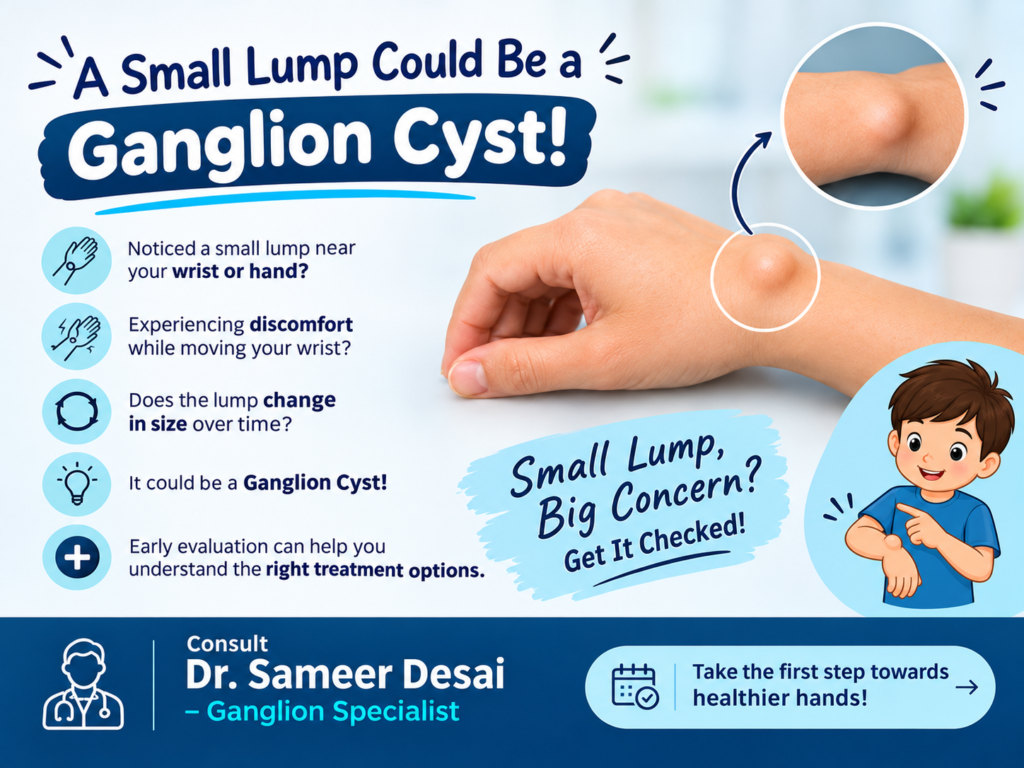
Have you recently noticed a small lump on your wrist or hand? Perhaps it appeared suddenly, or you have noticed that it becomes more prominent after certain activities. While discovering an unfamiliar lump can be worrying, not every swelling is a sign of a serious medical condition.
One possible explanation is a ganglion cyst, a common, non-cancerous, fluid-filled lump that usually develops near a joint or tendon.
Ganglion cysts can affect people of different ages, including children and adults. Some remain small and painless, while others may cause discomfort, restrict movement, or interfere with everyday activities.
Understanding what causes these lumps, how to recognise them, and when to seek medical advice can help you make informed decisions about your hand and wrist health.
What Is a Ganglion Cyst?
A ganglion cyst is a fluid-filled swelling that develops near a joint or tendon sheath. It contains a thick, jelly-like fluid similar to the lubricating fluid found inside joints.
These cysts most commonly appear on the back of the wrist, although they may also develop on the palm side of the wrist, near the fingers, or around other joints.
Unlike cancerous growths, ganglion cysts are benign. Many do not require treatment and may disappear naturally over time.
However, their appearance and size can vary. Some are barely noticeable, while others grow large enough to become uncomfortable or affect hand movement.
According to the American Academy of Orthopaedic Surgeons, ganglion cysts are among the most common lumps affecting the hand and wrist.
What Causes a Ganglion Cyst?
The exact cause of ganglion cyst formation is not fully understood.
A ganglion cyst develops when fluid collects within a sac connected to a joint or tendon sheath. Several factors may be associated with its development.
1. Repetitive wrist movements
Activities involving repeated wrist movement or pressure may contribute to symptoms or make an existing cyst more noticeable.
2. Joint or tendon irritation
Changes or irritation around joint tissues may be associated with the formation of these fluid-filled swellings.
3. Previous joint injuries
Some ganglion cysts may develop following an injury, although many appear without any identifiable injury.
4. Changes in joint tissues
Wear and tear or arthritic changes in certain finger joints can sometimes be associated with specific types of ganglion cysts.
Importantly, a ganglion cyst may develop even in someone who has never experienced a wrist injury or joint problem.
Common Signs and Symptoms of a Ganglion Cyst
Not every ganglion cyst causes pain. In fact, many people first notice a lump while washing their hands, wearing a watch, or performing daily activities.
Some common symptoms include:
-
A visible lump: A rounded swelling near the wrist, hand, or finger joint.
-
Changes in size: The lump may become larger or smaller over time.
-
Wrist discomfort: Pain or aching may occur during certain movements.
-
Limited movement: Larger or uncomfortable cysts may make some activities difficult.
-
Tingling or numbness: Occasionally, a cyst may press against a nearby nerve and cause altered sensation.
A ganglion cyst can also remain completely painless.
If the lump becomes painful, grows noticeably, or begins affecting hand function, an orthopaedic evaluation is advisable.
Can Children Develop Ganglion Cysts?
Yes. Although ganglion cysts are commonly discussed in adults, they can also develop in children and teenagers.
Parents may notice a small swelling on their child’s wrist while helping them dress, during playtime, or after sports activities.
In many cases, childhood ganglion cysts are painless and do not interfere with normal hand function.
Some may disappear naturally without medical intervention. Therefore, surgery is not automatically necessary simply because a child has a ganglion cyst.
However, parents should seek medical advice when the swelling becomes painful, increases in size, affects wrist movement, or causes unusual sensations.
An orthopaedic specialist can examine the lump and determine whether observation, further investigation, or treatment is appropriate.
How Is a Ganglion Cyst Diagnosed?
Diagnosis usually begins with a physical examination and a discussion of the patient’s symptoms.
The doctor may ask when the lump first appeared, whether its size has changed, and whether it causes pain during movement.
During the examination, the doctor assesses the lump’s location, consistency, tenderness, and relationship to nearby joints.
In some cases, additional investigations may be recommended.
Ultrasound: Helps determine whether the lump is fluid-filled or solid.
MRI scan: May be useful when a cyst is hidden beneath the skin, the diagnosis is uncertain, or nearby structures need further assessment.
X-ray: Does not directly show a ganglion cyst but may help identify associated bone or joint conditions.
Not every patient requires imaging. Many ganglion cysts can be recognised through clinical examination alone.
Does Every Ganglion Cyst Need Treatment?
No. Treatment depends on the cyst’s size, location, symptoms, and effect on daily activities.
1. Observation and monitoring
For a small, painless ganglion cyst, the doctor may recommend monitoring it rather than treating it immediately.
Some cysts shrink or disappear naturally over time. Regular observation can help identify changes that require further assessment.
2. Activity modification and wrist support
If certain movements cause discomfort, temporarily modifying those activities may help.
A wrist brace or splint may sometimes be recommended to reduce strain and relieve symptoms.
However, prolonged immobilisation should be avoided unless specifically advised by a healthcare professional.
3. Aspiration
Aspiration involves removing fluid from the cyst using a needle.
It may be considered for selected symptomatic cysts, particularly those located on the back of the wrist.
However, the cyst may return because its connection to the joint or tendon sheath remains.
Aspiration is not suitable for every cyst, especially when important nerves or blood vessels are nearby.
4. Surgical removal
Surgery may be considered when a ganglion cyst causes persistent pain, affects movement, or continues to interfere with normal activities despite conservative treatment.
During surgery, the cyst and its connecting stalk are removed.
Although surgery can provide symptom relief, there is still a possibility that the cyst may return.
The decision to operate should be based on an individual assessment rather than the appearance of the lump alone.
Why You Should Never Try to Burst a Ganglion Cyst at Home
Some people attempt to treat a ganglion cyst by pressing, hitting, puncturing, or squeezing it.
These methods are not recommended.
Trying to burst a cyst can damage nearby tissues, and puncturing it at home may introduce infection.
A wrist lump may also have another cause, making self-treatment particularly risky.
If a lump is bothering you, professional evaluation is safer than experimenting with home remedies.
When Should You Consult an Orthopaedic Specialist?
A small, painless cyst may not require urgent treatment, but certain changes should not be ignored.
Consider scheduling a consultation if the lump is growing, causing repeated pain, limiting hand or wrist movement, or producing numbness or weakness.
A lump that is unusually hard, fixed, or difficult to identify should also be examined rather than assumed to be a ganglion cyst.
Seek prompt medical attention if the swelling becomes very painful, red, hot, or is accompanied by fever. These symptoms may indicate another condition, including infection.
Early assessment helps establish the correct diagnosis and prevents unnecessary delays in managing a potentially different problem.
Ganglion Cyst Care with Dr. Sameer Desai
Dr. Sameer Desai is a paediatric orthopaedic surgeon in Pune who evaluates and manages musculoskeletal conditions affecting children.
His official website includes ganglion cysts among the orthopaedic conditions covered by his practice, alongside clubfoot, knock knees, trigger thumb, and other childhood bone and joint concerns.
Families seeking orthopaedic advice can learn more through the official website, Dr. Sameer Desai.
The clinic’s Google Business Profile name is:
Dr Sameer Desai | Paediatric Orthopedic Surgeon in Pune | Clubfoot | Knock Knees Specialist in pune
A consultation can help determine whether a child’s wrist lump is a ganglion cyst or another condition, and whether simple observation or further care is appropriate.
Frequently Asked Questions About Ganglion Cysts
1. Can a ganglion cyst disappear without surgery?
Yes. Some ganglion cysts shrink or disappear naturally, particularly when they are painless and do not affect joint movement. A doctor may recommend observation rather than immediate treatment.
2. Is a ganglion cyst dangerous?
Ganglion cysts are generally benign and are not cancerous. However, not every lump is a ganglion cyst. Any unusual, painful, or changing swelling should be examined to confirm its cause.
3. Can a ganglion cyst return after treatment?
Yes. Ganglion cysts can return after aspiration or surgical removal. The likelihood depends on factors such as the cyst’s location and the treatment performed. Your doctor can explain the expected benefits and limitations of each option.
Conclusion: Small Lump, Big Concern? Get It Checked
A small lump on your wrist or hand may seem alarming, but many ganglion cysts are harmless and do not require immediate treatment. Understanding the symptoms and seeking medical advice when necessary can help protect comfortable hand movement.
If you are looking for a Ganglion specialist in pune, you can consult Dr. Sameer Desai for an orthopaedic assessment, particularly for wrist and hand concerns affecting children. An accurate diagnosis helps determine whether monitoring, supportive care, or further treatment is appropriate.