
Understanding Bow Legs in Children
As children grow, parents closely observe every milestone, from their first steps to the way they walk and run. Sometimes, parents notice that their child’s legs appear curved outward, leaving a noticeable gap between the knees when the ankles are together. This condition is commonly known as bow legs in children, or medically as genu varum.
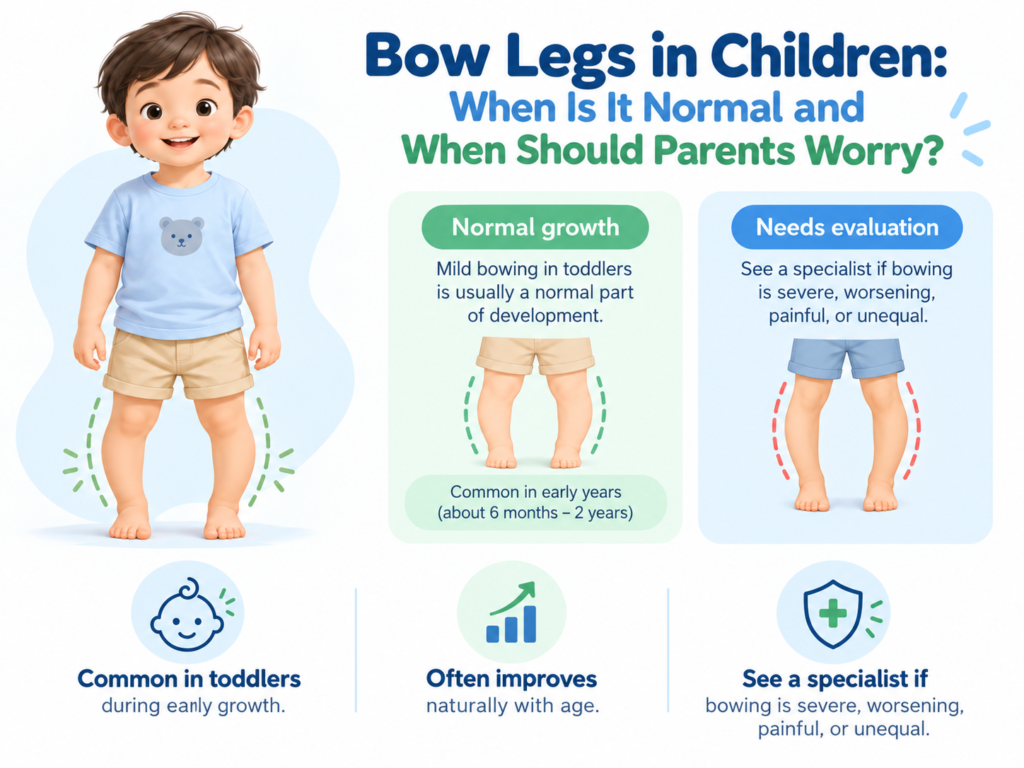
Although the appearance may concern parents, bow legs are often a normal part of early childhood development. Many babies and toddlers naturally have slightly bowed legs that gradually straighten as they grow.
However, not every case follows the same pattern. Sometimes, persistent or worsening bowing may indicate an underlying bone growth problem that requires medical evaluation.
Understanding the difference between normal development and concerning symptoms can help parents make informed decisions about their child’s bone health.
What Causes Bow Legs in Children?
There are several reasons why a child’s legs may appear bowed. Some are related to natural growth, while others involve medical conditions affecting bone development.
1. Normal Growth and Development
Most babies are born with some degree of leg bowing because of their position inside the womb. This natural curvature may become more noticeable when they begin standing or walking.
In most children, the legs gradually become straighter between 18 months and 3 years of age.
This is called physiological bowing, and it generally does not require medical treatment.
2. Vitamin D Deficiency and Rickets
Vitamin D plays an important role in helping the body absorb calcium and maintain healthy bones.
A deficiency of vitamin D, calcium or phosphorus may contribute to rickets, a condition that weakens developing bones.
Children affected by rickets may develop bowed legs, delayed growth or other skeletal changes. Early diagnosis and appropriate nutritional or medical treatment are important.
3. Blount’s Disease
Blount’s disease is a growth disorder affecting the upper part of the shinbone near the knee.
Unlike normal developmental bowing, this condition may become progressively worse as the child grows.
Early identification can help doctors determine whether observation, bracing or surgical correction is appropriate.
4. Other Bone Growth Conditions
Less commonly, bowed legs may develop because of inherited skeletal conditions, previous growth plate injuries or other disorders affecting bone development.
A detailed medical evaluation helps identify the underlying cause.
At What Age Are Bow Legs Considered Normal?
A child’s leg alignment changes naturally during development. Understanding these changes can help parents avoid unnecessary worry.
| Age | Typical leg development |
|---|---|
| Birth to 18 months | Mild outward bowing is common |
| 18 months to 2 years | Bowing usually begins to improve |
| 2 to 3 years | Legs generally become straighter |
| 3 to 4 years | Some children develop normal knock knees |
| Later childhood | Leg alignment gradually approaches its mature pattern |
These ages are approximate. Every child’s growth pattern is different.
If bowing continues beyond 2 to 3 years without improvement, a pediatric orthopedic assessment may be recommended.
When Should Parents Worry About Bow Legs?
Although mild, symmetrical bowing in toddlers is generally harmless, certain signs should not be ignored.
Parents should seek a medical opinion if they notice:
-
Severe bowing: The outward curvature appears unusually pronounced.
-
Unequal leg alignment: One leg appears more bowed than the other.
-
Increasing deformity: The bowing becomes more noticeable instead of improving.
-
Persistent bowing: The legs remain significantly bowed beyond the age of 3.
-
Pain or discomfort: The child experiences knee pain, leg pain or difficulty participating in normal activities.
-
Growth concerns: Bowing occurs alongside unusually short stature or other developmental concerns.
These symptoms do not necessarily indicate a serious condition. However, they can help doctors determine whether further investigation is needed.
Parents looking for a Bow Legs specialist in pune can consult a qualified pediatric orthopedic surgeon to understand whether their child’s leg alignment is developing normally.
How Are Bow Legs Diagnosed?
Diagnosing bow legs involves more than simply observing the appearance of the legs.
A paediatric orthopedic surgeon evaluates the child’s age, growth history, walking pattern and overall leg alignment.
Physical Examination
The doctor examines both legs to assess the degree of bowing, symmetry and movement around the knees and ankles.
The child’s walking pattern may also be observed to identify any unusual movement or difficulty.
X-ray Examination
Not every child with bow legs requires an X-ray.
However, imaging may be recommended when bowing is severe, asymmetric, worsening or persisting beyond the expected developmental age.
An X-ray can help assess bone alignment and identify possible growth plate abnormalities.
Blood Tests
When nutritional deficiencies or metabolic bone disorders are suspected, blood tests may be advised to assess vitamin D, calcium, phosphorus and other relevant markers.
The need for testing depends on the child’s symptoms and clinical findings.
What Are the Treatment Options for Bow Legs?
The most appropriate bow legs treatment depends on the child’s age, severity of the condition and underlying cause.
Observation and Regular Monitoring
For children with normal developmental bowing, observation is usually sufficient.
The doctor may recommend periodic follow-up appointments to monitor improvements in leg alignment as the child grows.
Nutritional and Medical Management
When bowed legs are associated with rickets or nutritional deficiencies, appropriate medical treatment and dietary guidance may help improve bone health.
Supplements should be used according to a doctor’s recommendations rather than given without evaluation.
Bracing for Selected Conditions
Specialized braces may be recommended for certain young children diagnosed with Blount’s disease.
However, braces are not generally necessary or effective for normal physiological bowing.
Surgical Correction
Surgery is considered only in selected cases involving significant, persistent or progressive deformity.
Depending on the child’s age and diagnosis, procedures such as guided growth surgery or corrective bone surgery may help improve alignment.
Most toddlers with normal developmental bowing do not need surgery.
Can Bow Legs Correct Themselves Naturally?
Yes. In most healthy toddlers, mild bowing improves naturally as the bones grow and leg alignment changes.
Parents do not need to force the child’s legs into a straight position or use special footwear to correct normal developmental bowing.
Special shoes, exercises and braces do not speed up the correction of physiological bow legs.
Supporting healthy growth through balanced nutrition, age-appropriate physical activity and regular pediatric checkups is generally helpful.
If parents remain concerned about their child’s leg alignment, a medical examination can provide reassurance or identify problems requiring attention.
Why Is Early Evaluation Important?
The purpose of early evaluation is not to recommend treatment for every child with bowed legs. It is to distinguish normal development from conditions that may progressively affect bone alignment.
Timely assessment may help identify problems such as Blount’s disease or rickets before they result in more significant deformity.
It also helps avoid unnecessary interventions in children whose legs are developing normally.
For parents, understanding the cause of bowing is often the first step toward making confident decisions about their child’s care.
Consult Dr. Sameer Desai for Bow Legs Evaluation in Pune
If your child’s legs appear unusually bowed, remain curved beyond the expected age or show signs of worsening alignment, consulting a pediatric orthopedic specialist can help.
Dr. Sameer Desai provides pediatric orthopedic consultation for children’s bone, joint and limb alignment concerns.
His Google Business Profile is listed as Dr Sameer Desai | Paediatric Orthopedic Surgeon in Pune | Clubfoot | Knock Knees.
A detailed clinical evaluation can help determine whether a child requires simple observation, additional investigations or a specific treatment plan.
Parents concerned about bow legs, knock knees, clubfoot or other pediatric limb deformities can seek professional guidance to understand their child’s orthopedic development.
Frequently Asked Questions About Bow Legs in Children
1. Are bow legs normal in a 1-year-old child?
Yes. Mild bowing is common in babies and toddlers, particularly when they begin walking. In most cases, the legs straighten gradually with growth.
2. At what age should bow legs disappear?
Normal developmental bowing generally improves between 18 months and 3 years. Persistent or worsening bowing may require medical assessment.
3. Can vitamin D deficiency cause bow legs?
Yes. Vitamin D deficiency can contribute to rickets, which may affect bone strength and alignment. However, not all children with bowed legs have vitamin D deficiency.
4. Do bow legs require surgery?
Most children with normal developmental bowing do not require surgery. Surgical treatment is reserved for selected cases involving significant deformity or an underlying medical condition.
5. Can massage or special shoes correct bow legs?
Massage and special shoes have not been shown to correct normal developmental bowing. Treatment should be based on the child’s diagnosis rather than appearance alone.
6. When should parents consult a pediatric orthopedic surgeon?
Medical evaluation is recommended if the bowing is severe, uneven, painful, worsening or persists beyond the expected age.
Conclusion
Bow legs are a common part of early childhood development, and most children experience natural improvement as they grow. Nevertheless, persistent, painful, severe or uneven bowing should not be overlooked.
Recognising changes in leg alignment and seeking appropriate medical advice can help identify conditions that require attention while avoiding unnecessary treatment.
Concerned about your child’s leg alignment? Consult Dr. Sameer Desai, Paediatric Orthopedic Surgeon in Pune, for a detailed evaluation and personalised guidance on healthy bone development.