
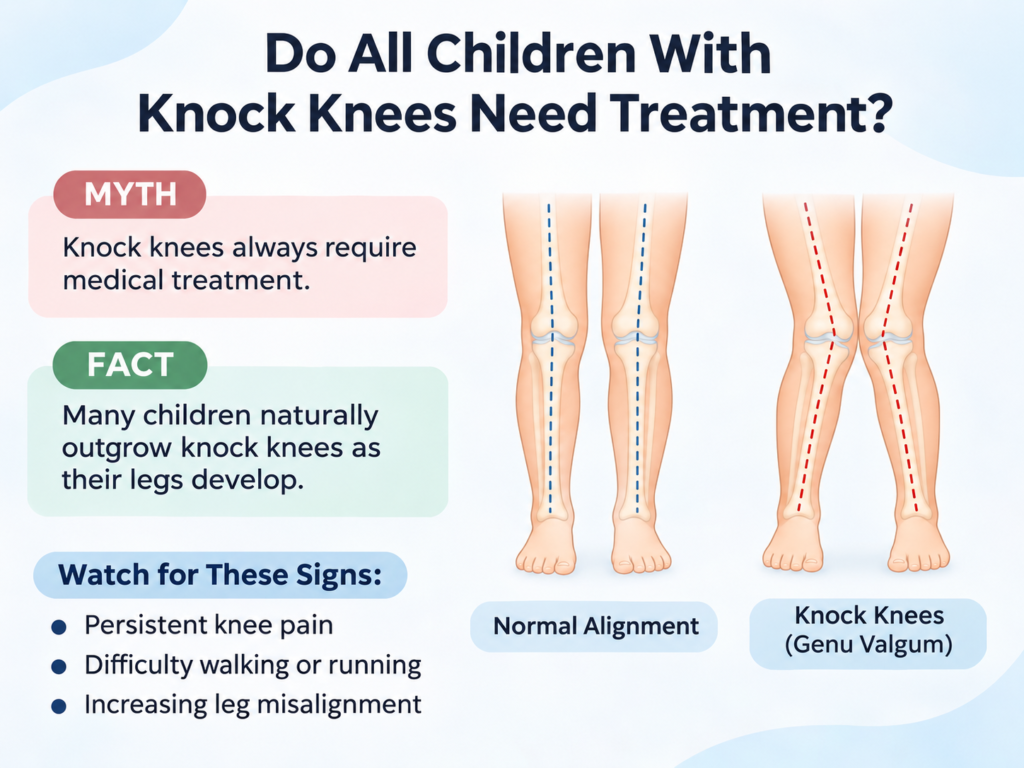
Watching a child grow brings many changes, from their first steps to the way they walk, run, and play. Sometimes, parents notice that their child’s knees seem to turn inward while standing. When the knees touch but the ankles remain apart, this condition is commonly known as knock knees.
Naturally, parents may wonder whether their child’s legs will straighten with age or whether medical treatment is necessary.
The reassuring news is that many children naturally outgrow knock knees without any treatment. However, not every case follows the same pattern. Understanding normal leg development and recognising unusual signs can help parents make informed decisions about their child’s bone health.
What Are Knock Knees in Children?
Knock knees, medically called genu valgum, is a condition in which a child’s knees angle inward toward each other while the ankles remain apart.
This alignment is particularly common during early childhood, when bones and joints are still developing.
For example, when a child stands with their knees touching, parents may notice a visible gap between the ankles. In many cases, this appearance is simply part of normal growth.
The important thing to understand is that children’s legs do not develop their adult alignment immediately. They undergo several natural changes during the growing years.
Can Knock Knees Correct Themselves Naturally?
Yes, most cases of knock knees in young children improve naturally as they grow.
During childhood, the alignment of the legs changes in stages.
-
Birth to 2 years: Many children have slightly bowed legs.
-
2 to 4 years: The legs gradually change alignment, and knock knees may become noticeable.
-
3 to 5 years: Knock knees are often most prominent.
-
6 to 8 years: The legs usually begin to develop a more mature alignment.
Most children experience significant improvement by approximately 7 to 8 years of age, although mild variations can remain normal.
If both legs are similarly affected, the child is comfortable, and the alignment gradually improves, treatment may not be necessary.
However, if the condition becomes more noticeable with age rather than improving, a medical evaluation is advisable.
Why Do Children Develop Knock Knees?
There is not always an underlying medical problem behind knock knees.
In many children, it is simply a normal stage of skeletal development. As bones grow and muscles become stronger, the alignment of the legs gradually changes.
However, certain factors may contribute to persistent or unusually severe knock knees.
1. Natural Bone Development
Young children’s bones are continuously growing. Temporary inward angling of the knees is often part of this process.
2. Nutritional Deficiencies
Conditions such as rickets, sometimes associated with vitamin D or calcium deficiency, can affect bone strength and alignment.
3. Previous Injuries
An injury involving the growth plate near the knee can occasionally affect how the leg develops.
4. Underlying Bone Conditions
Certain inherited or developmental bone disorders may influence the alignment of the legs.
5. Excess Body Weight
Higher body weight may place additional stress on growing joints and can be associated with more noticeable knee angulation.
A specialist assessment can help determine whether the condition is part of normal development or related to another cause.
When Should Parents Be Concerned About Knock Knees?
Although knock knees are common in children, certain symptoms should not be overlooked.
Parents should consider a medical consultation if they notice:
-
Persistent knee pain: The child frequently complains of discomfort in the knees or legs.
-
Difficulty walking or running: The child limps, struggles with normal activities, or experiences unusual difficulty moving.
-
Increasing leg misalignment: The inward angle becomes more pronounced instead of improving.
-
Uneven leg alignment: One leg appears significantly more affected than the other.
-
Persistent knock knees after age 7–8: The condition remains pronounced beyond the usual age of improvement.
These signs do not necessarily indicate a serious condition, but they may require closer examination.
Do All Children With Knock Knees Need Treatment?
No. This is one of the most common misconceptions about knock knees.
Many parents assume that visible knee misalignment automatically requires braces, special footwear, exercises, or surgery.
In reality, normal developmental knock knees usually do not require medical correction.
For children whose leg alignment is improving naturally, observation may be all that is needed.
Special shoes, braces, and corrective exercises generally do not change normal developmental knee alignment. They should not be used solely to straighten the legs without appropriate medical advice.
Treatment is considered when the condition is unusually severe, progressive, persistent, or associated with an underlying medical problem.
How Are Knock Knees Diagnosed?
When parents consult a paediatric orthopedic specialist, the evaluation usually begins with a physical examination.
The doctor may assess the child’s:
-
Standing posture and leg alignment
-
Walking and running pattern
-
Distance between the ankles when the knees touch
-
Joint movement and flexibility
-
Growth history and previous injuries
Most children with typical developmental knock knees do not need X-rays.
However, if the condition is severe, affects only one leg, or continues to worsen, imaging or additional investigations may be recommended.
The purpose of evaluation is not simply to identify inward knee alignment, but to understand whether it is appropriate for the child’s age.
What Treatment Options Are Available for Knock Knees?
Treatment depends on the child’s age, severity of the condition, remaining growth, and underlying cause.
Observation and Monitoring
For mild developmental knock knees, the doctor may recommend monitoring leg alignment as the child grows.
Treatment of Underlying Conditions
If nutritional deficiency or another bone disorder is identified, treating that condition becomes an important part of care.
Guided Growth Surgery
In selected children with significant misalignment who still have growth remaining, guided growth surgery may be considered. This procedure helps gradually correct the alignment by influencing growth around the knee.
Corrective Bone Surgery
In some severe cases, particularly when sufficient growth is no longer available for guided correction, an osteotomy may be considered to realign the bone.
Surgery is not required for most children with knock knees. The decision depends on an individual assessment.
Can Parents Help Improve Their Child’s Leg Health?
Parents can support healthy bone development through everyday habits.
Encourage age-appropriate physical activities, provide a balanced diet containing adequate calcium and vitamin D, and help the child maintain a healthy weight.
Allow children to participate in normal play and movement unless a doctor recommends restrictions.
Most importantly, avoid forcing the knees into a straighter position or using correction devices without professional guidance.
If the child’s walking pattern changes or symptoms develop, seeking timely medical advice is more useful than trying unproven home treatments.
Frequently Asked Questions
1. At what age do knock knees usually disappear?
Most developmental knock knees improve considerably by 7 to 8 years of age. Some children may take longer to develop their mature leg alignment.
2. Can exercises completely correct knock knees?
Exercises cannot reliably straighten bones affected by structural knock knees. Physical activity supports strength and mobility, but it does not replace appropriate treatment when significant skeletal misalignment is present.
3. Is surgery necessary for knock knees in children?
No. Most children do not require surgery. It is considered only in selected cases where the alignment is severe, worsening, persistent, or causing functional problems.
Conclusion
Knock knees are often a normal part of childhood development, and many children gradually develop straighter leg alignment without medical intervention.
However, persistent pain, difficulty walking, uneven knee alignment, or worsening symptoms should not be ignored.
Parents seeking a Knock Knees specialist in pune can consider consulting Dr Sameer Desai | Paediatric Orthopedic Surgeon in Pune for an evaluation of their child’s leg alignment and guidance on whether monitoring or treatment is appropriate.
Early assessment, when indicated, can help parents understand their child’s condition and make informed decisions about their growing bone health.