
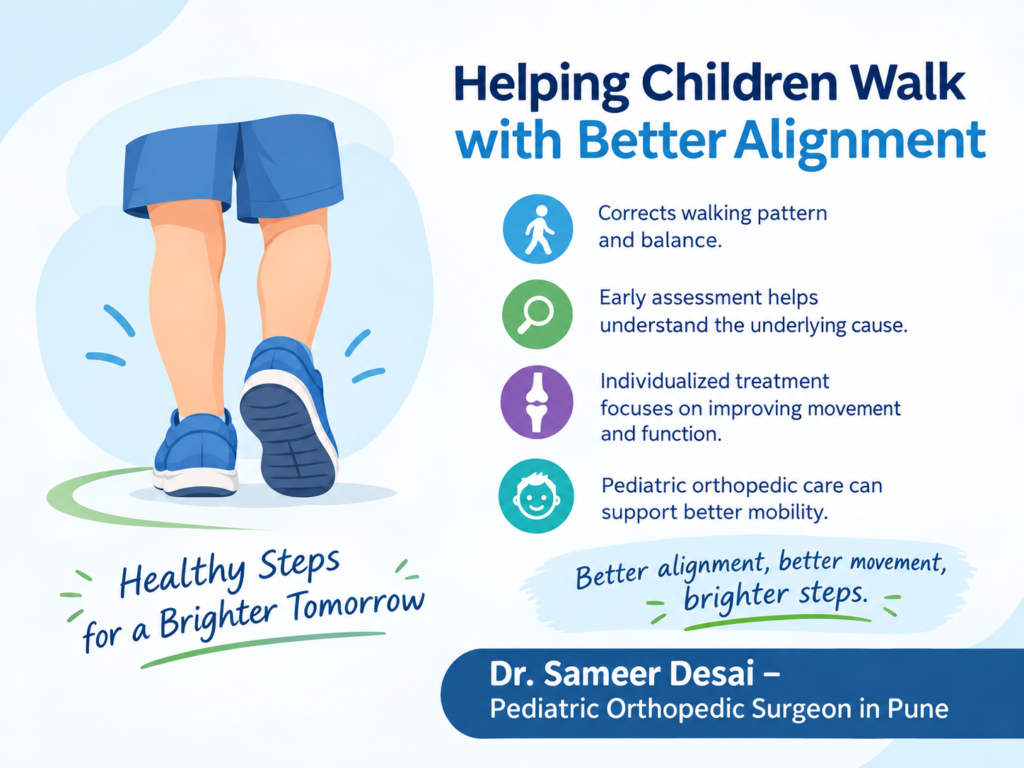
Walking is an important milestone in every child’s development. However, some children may develop an unusual walking pattern in which their legs cross or come close together while walking. This is commonly known as a scissoring gait.
Scissoring can affect a child’s balance, coordination and overall mobility. Identifying the underlying cause early can help in planning appropriate treatment and supporting better movement as the child grows.
What Is Scissoring Gait in Children?
Scissoring gait is a walking pattern where the legs move toward or cross over each other while taking steps. It can occur when certain muscles around the hips and legs become tight or overactive.
Parents may notice signs such as:
- Legs crossing while walking
- Difficulty maintaining balance
- Stiffness in the legs
- Walking with a narrow base
- Frequent tripping or difficulty taking steps
- Difficulty with smooth and coordinated movements
The cause can vary from child to child, so proper evaluation is important before deciding on treatment.
Why Is Early Assessment Important?
A child’s bones, muscles and joints continue to develop throughout childhood. An unusual walking pattern should therefore be assessed to understand whether it is related to muscle tightness, joint alignment, neurological conditions or another underlying concern.
Early assessment can help identify movement difficulties and allow treatment to be planned according to the child’s individual needs.
Scissoring Treatment in Pune
Scissoring treatment in Pune may vary depending on the child’s age, symptoms, muscle tone, flexibility and underlying condition.
Treatment may include:
Physiotherapy
Physiotherapy can help improve flexibility, muscle strength, balance and coordination. Specific exercises may also help the child develop better movement patterns.
Stretching and Muscle Management
When tight muscles contribute to scissoring, appropriate stretching and muscle management may be recommended to improve flexibility and movement.
Orthotic Support
Some children may benefit from braces or orthotic devices to support proper positioning and alignment of the legs and feet. The type of support depends on the child’s individual requirements.
Medical Treatment
In certain cases, additional medical treatment may be considered to manage excessive muscle tightness or improve movement.
Surgical Treatment
If significant muscle contractures or bone and joint alignment problems are present, surgery may sometimes be recommended. The decision depends on the child’s condition and detailed clinical assessment.
How a Pediatric Orthopedic Surgeon Can Help
Consulting a Pediatric orthopedic surgeon in Pune can help parents understand why their child is having difficulty walking and whether the problem requires treatment.
A pediatric orthopaedic evaluation focuses on the child’s developing bones, joints, muscles and overall movement. Based on the assessment, an individualized treatment plan can be suggested.
The goal of treatment is not simply to change the child’s walking pattern. It is to improve mobility, comfort, balance and functional movement while supporting healthy development.
When Should Parents Seek Medical Advice?
Parents should consider an evaluation if their child:
- Frequently crosses their legs while walking
- Has difficulty walking or maintaining balance
- Shows persistent leg stiffness
- Trips frequently
- Has difficulty standing or taking independent steps
- Shows a noticeable change in walking pattern
- Has difficulty keeping the legs properly aligned
Early professional assessment can help identify the underlying concern and determine whether treatment is needed.
Helping Children Take Better Steps
Every child develops at their own pace, but persistent walking difficulties should not be ignored. With appropriate assessment and individualized care, children with movement and alignment problems can receive support suited to their specific needs.
Dr Sameer Desai | Paediatric Orthopedic Surgeon in Pune provides specialized orthopaedic care for children with walking, alignment and movement-related concerns.
If your child’s legs cross while walking or you notice an unusual walking pattern, consulting a pediatric orthopaedic specialist can help you understand the cause and appropriate treatment options.