
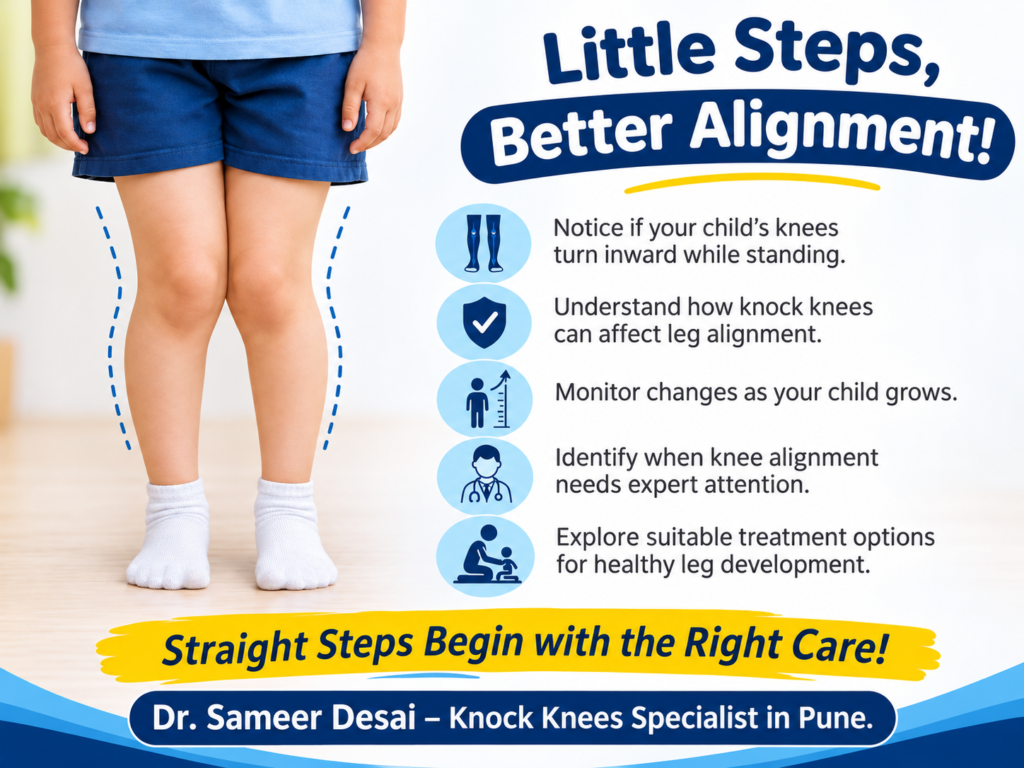
Watching your child take their first steps, run around the playground and explore the world is a wonderful experience. However, as children grow, parents may sometimes notice that their child’s knees turn inward while standing or walking. This condition, commonly known as knock knees, can raise concerns about posture, walking patterns and future mobility.
While knock knees are often a natural part of childhood development, certain cases may require medical attention. Understanding the difference between normal growth and abnormal leg alignment can help parents make informed decisions about their child’s orthopedic health.
What Are Knock Knees?
Knock knees, medically known as genu valgum, is a condition in which the knees angle inward and touch or come close together while the ankles remain apart.
Many children naturally develop knock knees between the ages of two and five years. In most cases, leg alignment gradually improves as the child grows, usually by the age of seven or eight.
However, when the condition persists, becomes more noticeable or affects everyday activities, an orthopedic assessment may be necessary.
What Causes Knock Knees in Children?
Knock knees can develop due to several reasons. While normal skeletal development is the most common cause, other contributing factors may include:
-
Vitamin D deficiency and rickets
-
Abnormal bone development
-
Previous injuries affecting growth plates
-
Excess body weight
-
Certain genetic or skeletal disorders
-
Underlying metabolic bone conditions
Identifying the underlying cause is important because not every child with knock knees requires treatment.
5 Signs Your Child’s Knock Knees May Need Medical Attention
Although mild knock knees are common during childhood, parents should pay attention to the following signs:
-
Persistent inward knee alignment: The condition does not improve beyond seven or eight years of age.
-
Difficulty walking or running: Your child struggles to participate comfortably in physical activities.
-
Uneven leg alignment: One knee appears more inward than the other.
-
Knee or leg discomfort: Your child frequently complains of pain or experiences a limp.
-
Progressive changes: The inward curvature becomes more noticeable as your child grows.
If you notice these signs, consulting a Pediatric Orthopedic Surgeon in Pune, such as Dr. Sameer Desai, can help determine whether your child’s leg alignment requires medical intervention.
Can Knock Knees Affect Your Child’s Future Mobility?
Mild knock knees associated with normal childhood development generally do not cause long-term complications. However, significant or persistent knee misalignment may affect how body weight is distributed across the knee joints.
In severe cases, untreated abnormal alignment may contribute to:
-
Increased stress on knee joints
-
Difficulty maintaining balance
-
Abnormal walking patterns
-
Discomfort during physical activities
-
Uneven pressure on joint surfaces
-
Potential joint problems later in life
An appropriate orthopedic evaluation can help identify whether these concerns are relevant to your child’s condition.
How Are Knock Knees Diagnosed?
Diagnosing knock knees involves more than simply observing how a child stands. An orthopedic specialist considers the child’s age, growth pattern, medical history and physical development.
The evaluation may include a physical examination, walking pattern assessment, measurement of leg alignment and, when necessary, standing X-rays or blood tests to investigate underlying bone conditions.
These findings help determine whether the condition is a normal developmental variation or requires further management.
What Are the Treatment Options for Knock Knees?
Treatment depends on the child’s age, severity of the condition and underlying cause.
1. Regular Monitoring
Most young children with developmental knock knees do not require active treatment. Periodic observation allows the doctor to monitor changes in leg alignment as the child grows.
2. Nutritional Management
When nutritional deficiencies contribute to abnormal bone development, appropriate vitamin D and calcium supplementation may be recommended following medical evaluation.
3. Physiotherapy and Physical Activity
Selected exercises may help improve muscle strength, stability and coordination. However, exercises alone cannot correct structural bone misalignment.
4. Guided Growth Surgery
For selected children with significant knock knees and sufficient remaining bone growth, guided growth surgery may help gradually correct leg alignment by modifying growth around the knee.
5. Corrective Surgery
In severe cases, particularly when skeletal growth is nearly complete, corrective bone surgery may be considered to improve alignment.
Not every child needs surgery. Treatment decisions should be based on individual clinical findings rather than appearance alone.
What Can Parents Do to Support Healthy Leg Development?
Small everyday habits can support your child’s overall musculoskeletal health.
Encourage regular age-appropriate physical activity, provide a balanced diet rich in calcium and vitamin D, maintain a healthy body weight and observe changes in walking patterns.
Avoid using corrective footwear, braces or home remedies without medical advice. These measures generally do not correct normal developmental knock knees.
Most importantly, avoid comparing your child’s physical development with that of other children. Every child’s growth journey is different.
Consult Dr. Sameer Desai – Knock Knees Specialist in Pune
Understanding your child’s growing bones is an important part of protecting their long-term mobility. Dr. Sameer Desai provides pediatric orthopedic evaluation for childhood bone and joint conditions, including knock knees, bow legs and walking abnormalities.
Parents looking for a Knock Knees Specialist in Pune can consult Dr. Sameer Desai to understand the condition, assess their child’s growth and explore suitable management options.
Google Business Profile: Dr Sameer Desai | Paediatric Orthopedic Surgeon in Pune
Timely assessment can help parents understand when simple observation is sufficient and when additional treatment may be beneficial.
Frequently Asked Questions
At what age should knock knees correct naturally?
Most developmental knock knees improve naturally by seven or eight years of age.
Can knock knees be corrected without surgery?
Yes. Most young children with developmental knock knees improve naturally without surgical intervention.
Can exercise straighten knock knees?
Exercise can improve muscle strength and stability but cannot reliably correct structural bone deformities.
Is knock knees a permanent condition?
Not necessarily. Childhood knock knees are frequently temporary, although persistent or pathological cases may require treatment.
Can children with knock knees participate in sports?
Most children with painless developmental knock knees can participate in normal physical activities. Children experiencing discomfort or mobility difficulties should undergo an orthopedic assessment.
Conclusion
Knock knees do not always indicate a serious orthopedic problem. In many children, they are simply a natural stage of growing up. However, recognising unusual changes and seeking timely medical guidance can make a meaningful difference.
Every little step matters. Understanding your child’s leg development today can help support comfortable movement and healthy mobility tomorrow.